

This Has Been a Journey!
I won’t do a full recap here, because my last post covered where I was in recovery. Since then, things have continued more or less according to plan.
I’m approaching week eight now and have been following the group physiotherapy program recommended by the hospital. My range of motion is almost fully back, which is encouraging, and overall the knee is moving well. At the end of next week — the end of week eight — I have my follow-up appointment with the surgeon, which feels like an important checkpoint in this whole process.
What I’ve come to realize during this phase of recovery is just how misleading it can be to compare one knee replacement to another, even when you expect them to be nearly identical. Same surgeon, same procedure, same body — it’s easy to assume the recovery will follow the same script.
That hasn’t been my experience.
Part A — Why No Two Knee Replacements Are the Same
My first knee replacement was defined by inflammation and joint pain. Swelling was the dominant issue, and the discomfort felt very much centred inside the joint itself.
This time, with my right knee, those particular problems haven’t really shown up. Instead, the challenge has been almost entirely muscle-related — muscle manipulation during surgery, deep bruising, and ongoing muscle pain that has affected how the joint feels and how I move. The knee itself hasn’t been the main issue; everything surrounding it has been.
That muscle pain has been stubborn and frustrating, and at times it’s made progress feel slower than expected. There were moments when it was hard not to compare this recovery to the first one and wonder why things felt so different.
But that comparison isn’t particularly helpful.
What has helped is accepting that each knee replacement comes with its own set of challenges. This one has simply been a different version of the same journey. The good news is that the muscle pain is improving — slowly, but noticeably — and that has made a real difference to how I’m moving day to day.
Part B — Small Interventions, Real Progress
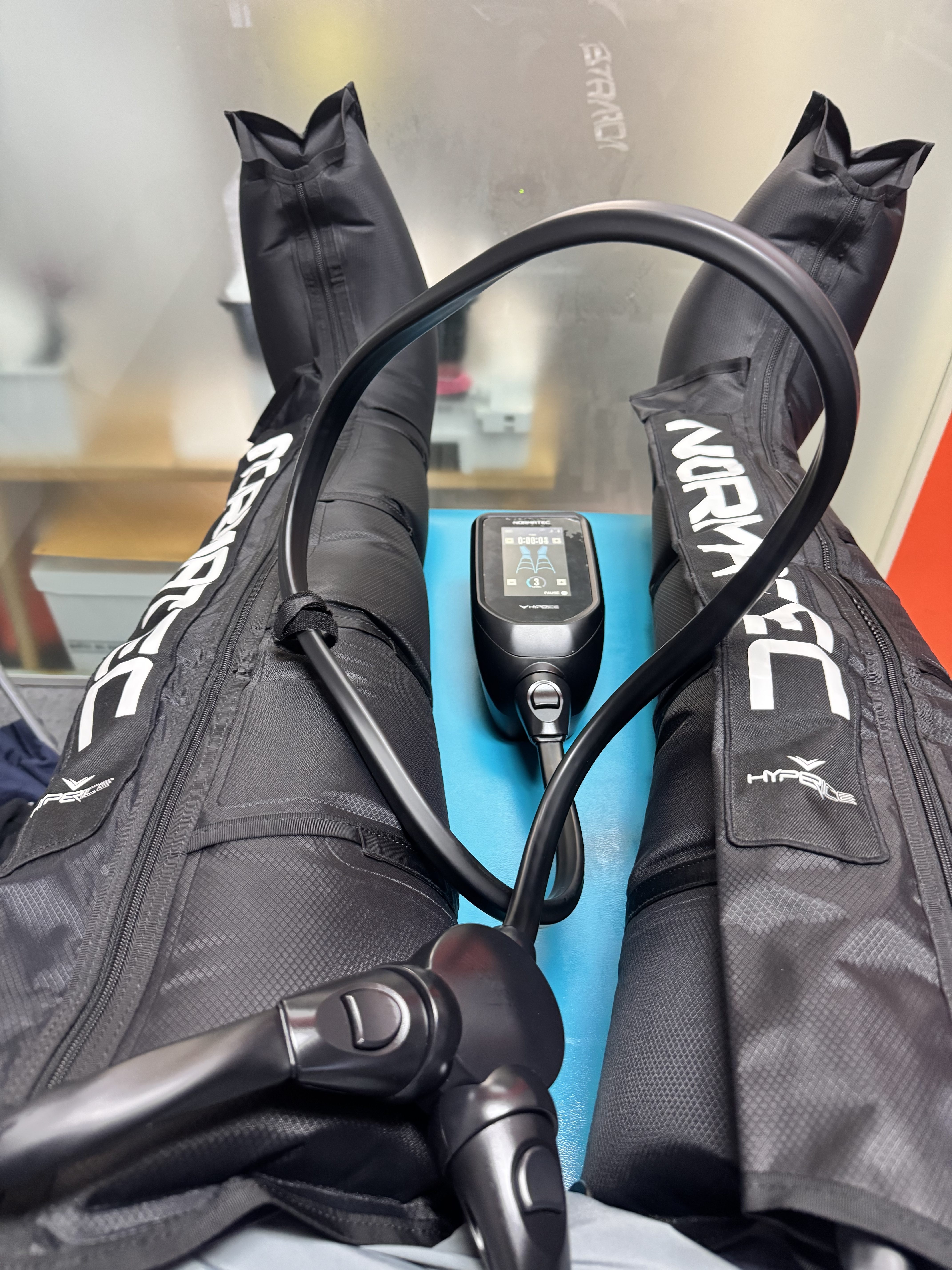
Alongside the hospital-based physiotherapy, I decided to book a few private physiotherapy sessions during this recovery. One of the most effective tools I’ve used — and something I hadn’t tried before — was compression boot therapy.
These boots cover the entire leg, from the foot all the way up to the hip. They’re zipped up tightly and connected to an air compressor that inflates the boots in sequence, starting at the toes and gradually moving upward.

The goal is to help move fluid and inflammatory byproducts into the lymphatic system, allowing the body to clear them more efficiently. In practical terms, it helps reduce swelling and that heavy, congested feeling in the leg.
I’ve had three compression boot treatments, and they’ve made a noticeable difference. Each session left my leg feeling lighter and less reactive — the kind of relief that’s hard to ignore once you experience it.
This week marked another important milestone: I was discharged from the group physiotherapy program after completing it successfully. For the first time since surgery, I’ve noticed a genuine decrease in pain. My walking has improved, my gait feels more natural, and things finally seem to be moving in the right direction.
For the first time in a while, it truly feels like there’s light at the end of the tunnel.
I believe I’m only a few weeks away from being fully recovered — and more importantly, from closing the chapter on years of pain caused by two severely arthritic knees. Looking back now, I’m glad I made the decision to have both knees replaced. The process hasn’t been easy, but at this point, it finally feels worth it.
As I head into my follow-up appointment next week, I’m doing so with cautious optimism — and with something I haven’t had in a long time: the real expectation of a pain-free life moving forward.
Keep Walking!
